

Do I need a lawyer for Canadian citizenship by descent?
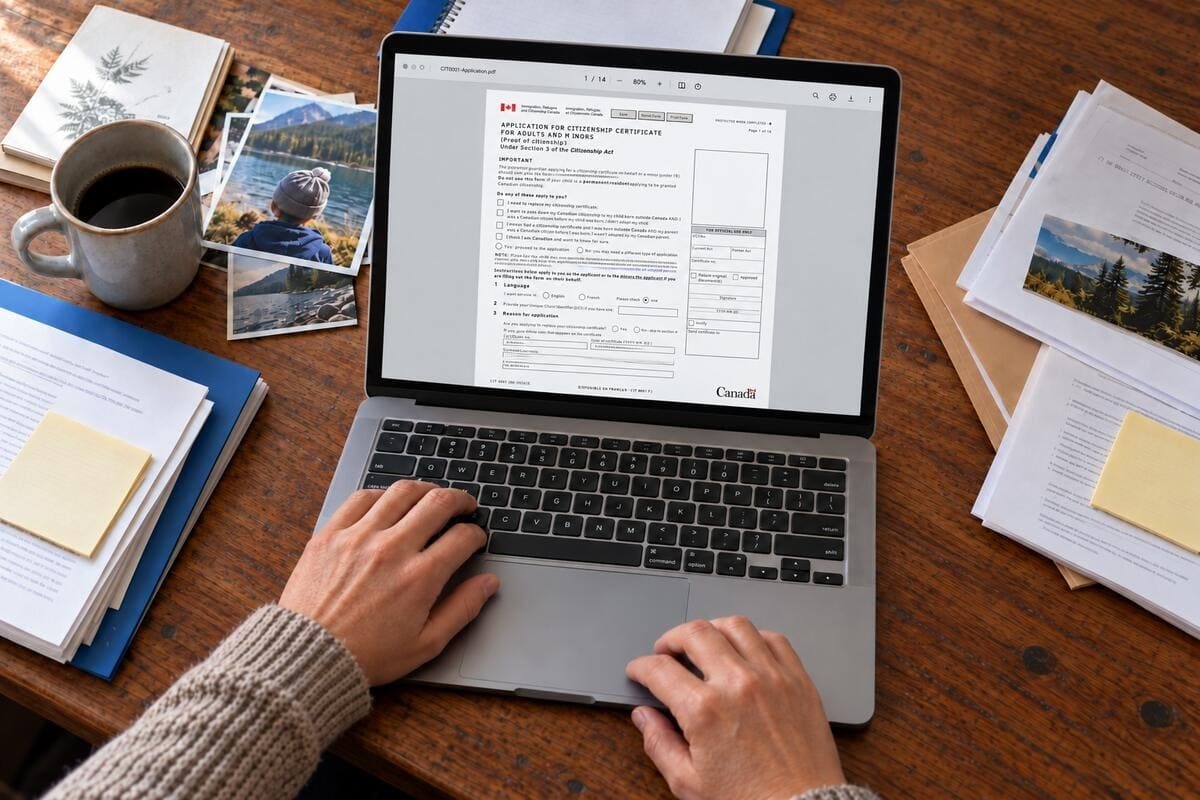
Since the passing of Bill C-3, millions of people are discovering that they are Canadian citizens by descent.
If you are in a similar situation, you might be wondering whether you can complete the process of applying for a Canadian citizenship certificate by yourself… or whether it's better to hire an immigration lawyer.
Whether you choose to go through the process yourself or with a lawyer, IRCC applies the same eligibility requirements. That said, hiring an immigration lawyer has several benefits, as they assess eligibility, review records, interpret applicable law, and help prepare an error-free application.
This page will outline what is required in each path so you can make an informed decision.
Table of contents
Overview
If you recently found out that you’re a Canadian citizen by descent through a parent, grandparent, or other ancestor, you might be wondering how to go through the application process.
Applicants can prepare a proof of citizenship application themselves or hire an immigration lawyer to handle some or all of it.
Most of the work in an application falls into the following areas:
- Tracing family lineage. Confirming how the Citizenship Act applies to a family line, including changes made in 1947, 1977 and 2009, and by Bill C-3, which removed the first-generation limit. Children born abroad on or after December 15, 2025, to a Canadian parent also born abroad face a physical presence requirement.
- Gathering supporting documentation. Some records don’t meet Canada’s citizenship department’s standards, such as Quebec birth certificates issued before January 1, 1994. When a record can’t be found, Immigration, Refugees and Citizenship Canada (IRCC) asks for a written explanation and proof of the search
- Preparing and submitting an application. Applicants also have to fill out a proof of citizenship form, have professional photographs taken, pay the necessary fees, and attach identity documents. After submitting the complete package, applicants also need to track the file and respond to any correspondence from IRCC. Applicants who want a lawyer to handle this submit a Use of a Representative form (IMM 5476).
Applicants with a clear family line to a Canadian ancestor and complete records may find the process manageable alone, while those with missing documents, conflicting records, a past refusal or lack of experience with Canada’s immigration system may want more in-depth legal advice.
DIY versus hiring an immigration lawyer
Here’s a look at how the process of submitting a proof of citizenship application compares at each stage.
Tracing family lineage
- Doing it yourself: Working out which ancestor connects you to Canada, and whether all subsequent generations fall within the rules.
There are some online tools such as our Citizenship by Descent Calculator, that can provide guidance - With a lawyer: A licensed professional will assess your eligibility for proof of citizenship, confirm which ancestor’s line your claim runs through, and flag issues like adoption or a break in the chain before you invest time and energy in document collection.
Gathering supporting documentation:
- Doing it yourself: This is usually the most time consuming part of the citizenship by descent process, and can get more complicated the more generations you need to go back. This process involves tracking down birth, marriage and immigration records, often across provinces, states or countries, and deciding what’s enough.
Note: Canada’s citizenship department does not just look at the documents but the body that issued them. Records must be from the original source authority that issues the document. - With a lawyer: An immigration lawyer may help you source some of documentation and will point you towards the right archive or agency for the rest. They usually do not do the bulk of document collection, unless you have paid for a specific package, but can tell you exactly what documentation is required for your case. Lawyers will also review and advise on your documents, spot discrepancies in names or dates before IRCC does, and recommend supporting evidence to fill gaps
Preparing and submitting an application
- Doing it yourself: This is the final part of the submission process. This involves the following:
- Filling out the proof of Canadian citizenship application form
- Sourcing the necessary identity documents
- Paying the fees and enclosing the receipt within the application package
- Having professional photos taken according to the Canadian government’s specifications
- Ensuring you have attached all the required supporting documentation
- Writing up a cover letter or letter of explanation, if needed
- Double-checking the application package to ensure there are no mistakes (incomplete packages risk being returned)
- Finally: monitoring for IRCC correspondence, responding to any requests that are received, and filing enquiries on your behalf, if needed
- With a lawyer: If you are submitting with the help of a lawyer, they will help with the final stage of the process. That means they will
- help craft letters of explanation or cover letters to explain any discrepancies
- Review the final file for any gaps or mistakes
- Advise on the identity documentation, fees and photos you submit
- Act as your representative of record. That means they will receive correspondence from IRCC directly and respond to requests for more information after submission
| Part of the process | Consideration | Applying independently | With a lawyer |
|---|---|---|---|
Assessing family lineage | Eligibility assessment | Applicant researches official guidance | Lawyer gives case-specific legal assessment |
Gathering supporting documentation | Sourcing documents | Applicant identifies, obtains and checks records | Lawyer advises on evidence and identifies issues. Lawyers may also be able to source certain documentation |
Gathering supporting documentation | Explain discrepancies | Applicant will need to explain any discrepancies between documents such as name changes, incorrect spellings or years. | Lawyers can draft an explanation letter and a cover letter, and provide guidance on sourcing no-record letters |
Preparing and submitting the application | Application preparation | Applicant completes and submits materials | Lawyer may prepare, review and submit when authorized |
Preparing and submitting the application | Time and effort | Applicant handles research and administrative work | Lawyer handles research and administrative work. Some work may be delegated; applicant still supplies documents |
Preparing and submitting the application | Cost | Government and document-related expenses (e.g., retrieval costs, translation, etc.) | Government and document-related expenses plus professional legal fees (approximately $3,000 to $10,000 CAD). |
Preparing and submitting the application | IRCC assessment | Same citizenship law and requirements | Same requirements; no preferential treatment |
If you want to go through the process independently of a lawyer, read our step-by-step guide on how to apply for Canadian citizenship by descent.
When might hiring a lawyer be helpful for your application?
There are many reasons to opt for a legal professional to handle a Canadian citizenship by descent application, such as the situations listed below.
You’re unsure about where to start or how to proceed
Between figuring out which documents are needed, gathering those documents from different sources, and filling out the application form, applying for proof of Canadian citizenship can be a complicated process. Having an immigration lawyer to guide you through it can help you gain clarity at any step in proving a line of descent from a Canadian.
Your claim involves adoption, renunciations, or other complex scenarios
Some family lines include events that change whether citizenship passed from one generation to the next. A person adopted abroad by a Canadian doesn’t become a citizen automatically. They first need a direct grant of citizenship or naturalization, and their descendants must prove that step took place. An ancestor who renounced citizenship, had it revoked or lost it under earlier laws may also have broken the line.
Records with conflicting names or dates can raise further questions from IRCC. Because the outcome depends on dates, the law in force at the time and the available evidence, applicants in these situations may want a lawyer’s assessment before applying.
There are discrepancies in names and dates in records
The more generations involved in proving your line of descent, the greater the chances of a name or date discrepancy in your documents. For example, one document could list an ancestor as Marie, while another lists the same person as "Mary."
This can lead to IRCC stalling the processing of your application or denying it altogether. These issues are often fixable with a letter of explanation, something an immigration lawyer can help you draft.
You want to minimize mistakes
Processing times have been increasing (34 months as of October 9, 2026), and any mistakes, including an incomplete application, could extend an already long process.
You want to save time
Regardless of complexity, filling out and submitting your Canadian citizenship certificate application takes a significant amount of time and effort. If you’re struggling to find time to go through the entire process yourself, it could be useful to outsource it to a lawyer with the relevant expertise.
Contact Cohen Immigration Law for Canadian Citizenship Assistance
Seeking legal advice to prove your line of descent from a Canadian citizen? The Cohen Immigration Law Firm can help. Cohen Immigration Law offers over 50 years of expertise helping people navigate Canadian immigration and citizenship rules, including applying for proof of Canadian citizenship.
You can also confirm your eligibility first using CanadaVisa's citizenship by descent eligibility checker, or read more about applying for proof of Canadian citizenship.
Get a Free Consultation on applying for Canadian Citizenship