

Documents needed for Canadian citizenship by descent
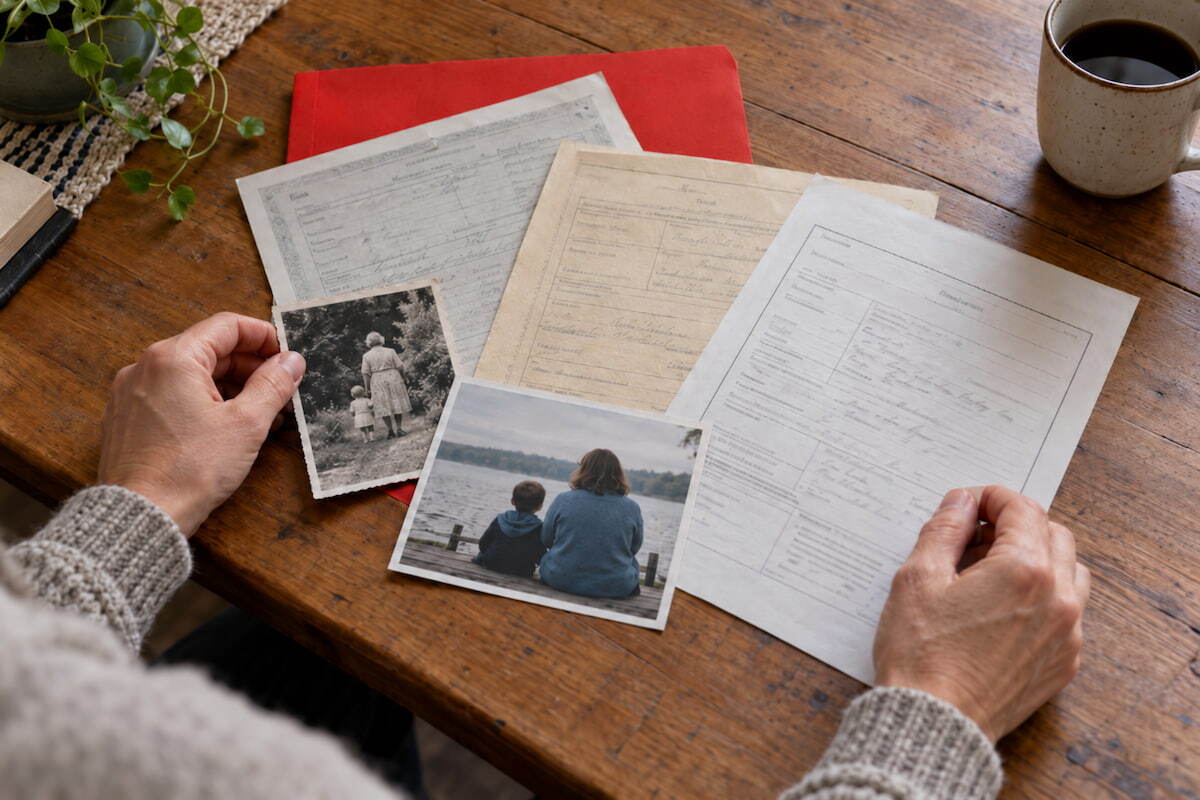
Even one Canadian ancestor in your lineage could mean you’re already a Canadian citizen.
Formally claiming that status requires proving it to Immigration, Refugees and Citizenship Canada (IRCC), one generation at a time, with official records to connect you to your Canadian relative.
This page breaks down the documents IRCC looks for, how it weighs them and what to do when a record is missing. Successful applicants receive a citizenship certificate, the document needed to apply for a Canadian passport.
Table of contents
Overview
People born outside Canada to a Canadian parent may already be Canadian citizens. A citizenship certificate is the document that proves this status and is needed to apply for a Canadian passport. To get one, applicants show an unbroken line from themselves back to a Canadian ancestor.
Documents needed for a proof of citizenship application to claim Canadian citizenship by descent can be categorized into standard application documents, and supporting documentation to prove a Canadian lineage. The latter category is often where the success of the application hinges, and where most of the work in assembling a complete application takes place.
Immigration, Refugees and Citizenship Canada (IRCC) requires authentic, reliable and verifiable documents for every generation in an application. This page explains what those documents are, and the provincial guides below explain where to find them.
Documents that prove a Canadian lineage
An application must connect the applicant to a Canadian ancestor through each generation in between. IRCC calls this person the Canadian parental ancestor. Some records carry primary evidence, the type IRCC gives the most weight. Others carry secondary evidence, which supports a claim but carries less weight. These terms describe evidentiary weight, not where a record comes from. Read more about primary and secondary evidence.
Lineage documents do four jobs.
1. Prove the ancestor was a Canadian citizen
The line must start with an ancestor who was born or naturalized in Canada on or after January 1, 1947, under the Citizenship Act, or who otherwise became a Canadian citizen on or after that date. For Newfoundland and Labrador, the date is April 1, 1949. Some ancestors qualify through British subject status.
For this ancestor, IRCC accepts 1 or more of these documents, issued by the original authority:
- a provincial or territorial birth certificate
- a Canadian citizenship or naturalization certificate
- a Certificate of Registration of Birth Abroad or a Certificate of Retention of Canadian Citizenship
- a British naturalization certificate issued in Canada or Newfoundland and Labrador
- proof of British subject status before January 1, 1947 (April 1, 1949, for Newfoundland and Labrador)
- proof of landed immigrant status in Canada before January 1, 1947 (April 1, 1949, for Newfoundland and Labrador)
When the ancestor was born in Canada, applicants often find that a provincial or territorial birth certificate is the most direct record to look for first.
2. Prove each parent-child link
IRCC asks for a document for every generation that shows the parent-child relationship. In most cases, that’s a birth certificate.
- The applicant’s own birth certificate. IRCC requires a birth certificate that displays the name of the Canadian parent who was the applicant’s legal parent at birth, issued by the original government authority in the country of birth.
- Birth certificates from other countries. IRCC accepts these for each generation if they show the parent-child relationship.
- Canadian birth certificates. These can link a child to Canadian-born parents and prove citizenship at the same time.
When the Canadian parent isn’t named on the applicant’s birth certificate, IRCC asks for other birth records that confirm the parent’s name, such as hospital records, court orders or pre-birth orders. IRCC also asks for a written explanation of why the parent isn’t listed.
3. Explain name changes, if applicable
Names change across generations through marriage, legal name changes and new spellings. When a name on one record doesn’t match the next, a document that connects the two can help an officer follow the line.
- Marriage certificates connect a woman’s birth surname to her married surname.
- Legal change of name documents, court orders, adoption orders and divorce decrees can explain other changes.
- Records with consistent details, such as the same parents, dates and places, can help show that two spellings belong to one person.
If the applicant’s own name differs from the name on their birth certificate, IRCC asks for proof of the legal change of name.
4. Answer questions IRCC may have about the line
IRCC asks some applicants for extra documents, depending on when they and their parent were born and whether amendments such as Bill C-3 apply.
- Other nationalities before February 15, 1977. IRCC asks for proof of any other nationality the applicant or their Canadian parent acquired before this date, if it applies.
- Births on or after December 15, 2025. Applicants born abroad on or after this date to a Canadian parent who was also born abroad must show that parent spent at least 1,095 days in Canada before the applicant’s birth. IRCC asks for the How to Calculate Physical Presence in Canada for a Canadian Parent (CIT 0555) form, along with evidence such as travel, school, employment or lease records.
Documents that families applying together can share
Siblings, cousins and children who descend from the same Canadian ancestor share many lineage documents. The ancestor’s records, and every record above the point where family branches split, apply to everyone in that line. Each person still needs their own birth certificate, identification, photos and forms.
Each application needs its own copies of the documents. IRCC states that if several family applications are sent together and one is incomplete, it returns all of them.
Where to find records, province by province
Each province keeps its birth, marriage and death records in its own vital statistics office and archives, such as Quebec’s Directeur de l’état civil. Our provincial guides outline which office holds which records, what information a request typically requires and how older records can be searched.
- Alberta
- Manitoba
- New Brunswick
- Newfoundland and Labrador
- Nova Scotia
- Ontario
- Prince Edward Island
- Quebec
- Saskatchewan
Some family lines also cross borders. For records from another country, IRCC requires documents issued by the original government authority in that country.
Documents every application needs
The Document Checklist (CIT 0014) lists the items IRCC requires from every proof of citizenship applicant. IRCC instructs applicants not to send originals unless the checklist says to, as submitted documents aren’t returned.
Application forms
- Application for a Citizenship Certificate (CIT 0001), completed, signed and dated. Online applicants complete the form through IRCC’s portal.
- Document Checklist (CIT 0014). IRCC requires paper applicants to include the completed checklist in their envelope. The online system creates a personalized checklist.
Identification
IRCC requires 2 pieces of valid identification, such as a passport, driver’s licence or health insurance card. At least 1 must include the applicant’s photo. Paper applications use colour copies, and online applications use colour scans.
Proof of fee payment
Paper applications include proof that the application fee was paid. Online applicants pay through the portal.
Documents some applicants need depending on their circumstances
- Use of a Representative form (IMM 5476), when a lawyer or other representative handles the application
- Proof of legal change of name form, when the applicant’s name has changed
- Statutory Declaration: Request for a Change of Sex or Gender, when it applies
- CIT-0555 form and physical presence evidence, as described above
- Translations of any document not in English or French, plus an affidavit from the translator
Citizenship photo requirements
Photo problems are among the most common reasons Cohen Immigration Law’s lawyers see applications come back. IRCC publishes separate photo rules for paper and online applications, so the requirements depend on how the application is submitted.
| Paper application | Online application | |
|---|---|---|
Number of photos | 2 identical colour prints | 1 colour digital photo |
Who takes it | A commercial photographer or studio | A commercial photographer or studio |
Photo size | 50 mm wide by 70 mm high (2 in by 2¾ in) | 50 mm wide by 70 mm high (2 in by 2¾ in) |
Face size (chin to crown) | 31 mm to 36 mm (1¼ in to 1 7/16 in) | 31 mm to 36 mm (1¼ in to 1 7/16 in) |
Format | Printed on plain, high-quality photo paper | JPG or JPEG, saved straight from the camera with minimal compression |
Resolution and file size | Not applicable | At least 420 by 540 pixels; about 240 kB, and no more than 4 MB |
Photo details | On the back: the person’s first and last name, the studio’s name and full address, and the date taken | On the photo receipt or in a separate text file |
Age of photo | Taken within 6 months before the application is submitted | Taken within 6 months before the application is submitted |
IRCC applies the same rules to the photo itself in both formats.
Lighting and background
- Plain white or light-coloured background
- Even lighting, with no shadows, glare or flash reflections
- Clear contrast between the face and the background, and natural skin tones
- No shadows around the ears, in the background, or across the face or shoulders
Pose and expression
- Face and shoulders centred and square to the camera
- Neutral expression, with eyes open and mouth closed
- Hair worn up or down
Glasses and head coverings
- IRCC accepts glasses if the eyes are clearly visible, the frames don’t cover them and the lenses show no glare.
- IRCC doesn’t accept sunglasses or tinted lenses, including tinted prescription glasses.
- IRCC accepts head coverings only when worn daily for religious or medical reasons. The full face must show, with no shadows.
- For medical headwear or a nasal cannula, IRCC asks for a signed letter explaining the reason, and may ask for a letter from a doctor.
No alterations
IRCC doesn’t accept photos that have been edited in any way. That includes:
- adjusting colour, brightness, contrast or sharpness
- cropping, or cutting the person out and placing them on a white background
- removing red-eye, glare, shadows, wrinkles or blemishes
- changing facial features, hair colour, clothing or background
Children, babies and wheelchair users
- Children’s photos show the head and shoulders only, with no hands from the child or a parent.
- IRCC allows a newborn’s photo to be taken in a car seat if a white blanket covers the seat behind the baby’s head.
- For people who use a wheelchair, IRCC asks for a white blanket behind the head so the edges of the face are clearly visible.
IRCC’s photo specifications for paper applications and online applications include example images.
How IRCC assesses documents
IRCC considers every document and piece of information submitted with an application. Officers then decide the claim on a balance of probabilities. Knowing how IRCC judges records can help applicants decide which ones to request.
The original-authority rule
IRCC requires documents issued by the original authority that created or keeps the record, such as a civil registry or vital statistics office. Each document must clearly show who issued it.
Copies, scans and certification
For paper applications, IRCC asks for clear, high-quality colour copies. For online applications, it asks for high-resolution colour scans or digital images. IRCC doesn’t require certified copies, but an officer may request one if they have concerns about a document.
Third-party records
IRCC states that an application can’t be supported solely by third-party records, such as printouts from genealogy websites or published biographies. IRCC notes that when these records exist, official documents likely exist too, and that applicants should request them from the original authority.
Translations
For any document not in English or French, IRCC requires an English or French translation and an affidavit from the person who translated it. IRCC doesn’t accept translations done by family members.
The balance of probabilities standard
IRCC doesn’t require applicants to prove their lineage beyond all doubt. An officer weighs all the evidence together and decides whether the claim is more likely true than not. That standard is called the balance of probabilities.
Under this standard, complete and consistent records tend to strengthen an application, while gaps and contradictions tend to weaken it. The standard also determines how far secondary evidence can go.
Primary and secondary evidence
IRCC sorts lineage documents into primary and secondary evidence. These terms describe evidentiary weight: how much a record proves about citizenship or a parent-child link. They don’t describe where the document comes from. IRCC expects both kinds to come from the original authority that keeps the record.
A baptismal record shows the difference. Even when it comes from the parish that created it, it carries secondary weight. It records a baptism, while a birth certificate records the birth itself.
| Primary evidence (most weight) | Secondary evidence (supporting weight) |
|---|---|
Provincial or territorial birth certificate | Hospital record of birth |
Birth certificate from another country that shows the parent-child relationship | Record from a physician or midwife who witnessed the birth |
Canadian citizenship or naturalization certificate | Baptismal certificate or record |
Certificate of Registration of Birth Abroad or Certificate of Retention of Canadian Citizenship | Census records |
British naturalization certificate issued in Canada or Newfoundland and Labrador | Canada Gazette records (until 1952, the Gazette published names of naturalized citizens and of people who lost citizenship or British subject status) |
Proof of British subject status before January 1, 1947 (April 1, 1949, for Newfoundland and Labrador) | Boat manifests |
Proof of landed immigrant status in Canada before January 1, 1947 (April 1, 1949, for Newfoundland and Labrador) | Marriage records |
Death records | |
Immigration records, including homestead records | |
Military records | |
Passports |
IRCC’s list of secondary evidence isn’t exhaustive. Officers must assess all relevant evidence an applicant provides.
How far secondary evidence can go
A single secondary record can’t make up for a missing primary document. A baptismal record on its own, for example, doesn’t replace a missing birth certificate.
Secondary evidence helps within the balance of probabilities. Several consistent records that point to the same facts carry more weight together than any one of them alone. A baptismal record, a census entry and a marriage record that agree on names, dates and places build a stronger picture than any single record.
Secondary evidence also doesn’t replace the search for the primary record. IRCC still expects applicants to show that they tried to get it.
When records are missing
Fires, floods, unregistered births and lost parish books leave gaps in many family lines. IRCC accepts that some official documents can’t be found. It also sets clear expectations for what an applicant submits when that happens.
IRCC’s standard for missing documents
When an applicant can’t provide a document issued by the original authority, IRCC requires two things:
- A written explanation. The applicant must explain in writing why they can’t provide the document.
- Proof of the attempt. The applicant must show proof that they tried to get it.
IRCC gives examples of acceptable proof, including emails or letters exchanged with the issuing authority, and confirmation from that authority that the record isn’t available. IRCC’s guidance to the archival community describes the same standard: the applicant must demonstrate in writing that efforts were made to obtain the documents, and explain why they can’t be provided.
IRCC then weighs the explanation and proof alongside every other document in the application. A written explanation without proof of the attempt doesn’t meet IRCC’s standard.
Ways applicants document a search
IRCC doesn’t prescribe a format for the proof. Applicants in this situation may find value in the following practices, which go beyond IRCC’s stated requirements:
- Contacting every office that may hold the record. A record may sit with a vital statistics office, a provincial archive or a church. Requests to each one show a thorough search.
- Keeping all correspondence. Request forms, emails, letters, receipts and replies can all serve as proof of the attempt.
- Requesting a “no record found” letter. When an office searches and finds nothing, written confirmation from that office directly matches the type of proof IRCC describes.
- Keeping a dated search log. A log that records each request, the office, the names and spellings searched, the date range and the result can make the written explanation easier to prepare and to check.
- Gathering secondary evidence for the gap. Records that cover the same person and event from different sources can support the claim under the balance of probabilities.
What a written explanation may cover
An explanation that names the missing record, lists where and when the applicant searched, and summarizes each office’s response gives an officer a clear account. It may also identify the secondary evidence submitted in place of the missing record, with the correspondence and “no record found” letters attached.
Missing records add complexity to an application. Applicants facing gaps in their documents may find it useful to have a lawyer review their search and evidence before submitting.
Contact Cohen Immigration Law for Canadian Citizenship Assistance
Cohen Immigration Law has helped clients with Canadian immigration and citizenship for over 50 years. Our dedicated citizenship team can review family records, advise on expected processing times, identify gaps and help build a complete proof of citizenship application.
You can also confirm your eligibility first using CanadaVisa's citizenship by descent eligibility checker, or read more about applying for proof of Canadian citizenship.
Get a Free Consultation on applying for Canadian Citizenship